


I just finished Nausea, by Jean Paul Sartre and what am I glad that I read this work.
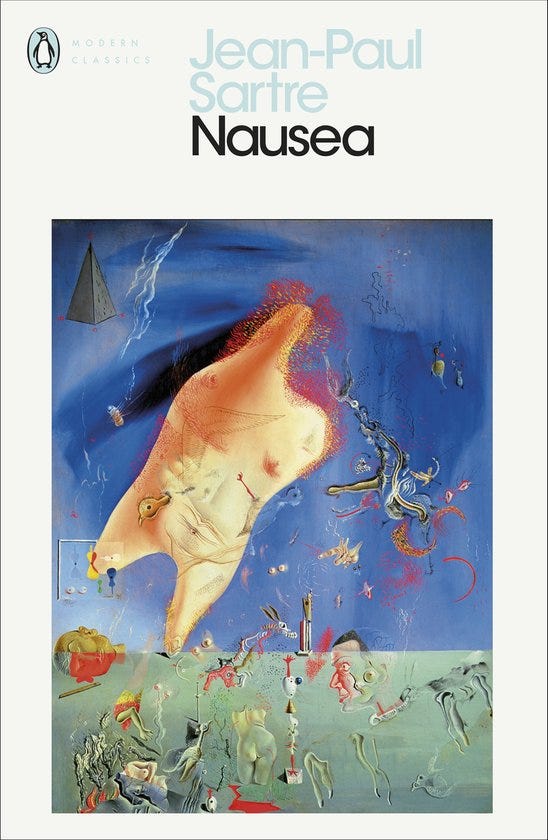
The novel tells the story of Monsieur Roquentin through his diary. During the story Roquentin writes a book about a historical figure, Marquis de Rollebon, but during his daily life whilst writing it, he was painfully aware of his own existence.
He stopped writing the book, saying that him writing a book about a historical figure is actually just him putting a dead man back into existence, so he can forget about his own. He is very isolated and bitter, he is even proud of this. He even believes that if others knew what he knew, that they would then spend their entire day spiraling and contemplating about their existence in solitude as well. When every object he passes and his own very existence starts to overwhelm his Nausea begins, a word that he uses to describe an overwhelming feeling of existential dread.
His past, or rather how he describes his past is extremely vague. One moment he describes having seen the entire world, the other he is explaining how he never truly lived, how he doesn’t really have a past. I found the character because of his spitefulness and his hyper awareness to be very similar to Dostoevsky’s Underground Man.
The most unsettling part of this book is that the main character just keeps spiraling in existential dread, without trying to find a solution to his state, he doesn’t try to pull himself together whatsoever. He constantly describes every experience in an uncomfortable disorderly way: The permanent sea of water under his tongue, the parts of wood engineered together into a thing where we can sit on that we so happen to call a chair.
He takes an object that most of label without any further thought, “chair”. Instead he dissects all the elements and materials of the object and describes how they are put together. He argues that the object is just raw existence and that only when we decide the object is something, only then it can truly be something. As its essence is defined by the meaning we give to it, not by the object itself.
As you might can imagine, going through day-to-day life and dismantling everything you see and simultaneously pondering your own existence is very exhausting and numbing.
In my view Sartre explained the absurdity of existence very well. Before I started this book, I sometimes spend way too much of my time like Roquentin, just thinking to myself how weird it is that I even am. However, after reading this I came to the conclusion that this is just no way to live. It leads to being so aware of your own existence that in the mean time you forget to even live at all, you forget to do something with that existence that you seem to care so much about. Although I do understand that this is easier said than done. Once you’re caught up in a Nausea like Roquentin, you don’t just get rid of it.
However just because life is absurd and unexplainable doesn’t mean that it isn’t worthwhile. We can make art, we can laugh and we can love. Even in the darkest of moments where nothing seems real anymore, when you encounter people who need help, and you are able to help them, those moments are real and beautiful. Even though you and them will eventually die, even though your existences are both as transitory, those moments of love and care are still beautiful and valuable. As they don’t need eternal existence in order to have beauty or to be meaningful. May you harvest as much joy as you can from the smallest moments, as transitory as they may be.
Love it!!!