


During Joseph Folley’s book club I made a comparison to Ivan Karamazov from Dostoevsky’s The Brothers Karamazov and Bazarov from Fathers and Sons by Turgenev. The reason I compared the two was because of their shared faith in rationality, holding in aspiration to become just as indifferent to feelings as the laws of physics are, the most striking factor they held in common was how they miserably failed to obey this belief. These non-practicing rationalists were actually easily swept by the tide of emotion leading their actions to not even be a fraction as predictable as their ideal mathematical constants were.
Folley responded with a very interesting remark, how after Ivan Karamazov left his hometown he was sure nobody would miss him being there, but the one who would actually end up missing him, was himself. This observation wandered in my mind for quite some time; how big is the distance between a person and his beliefs, how big is the distance between a person and his very own actions?
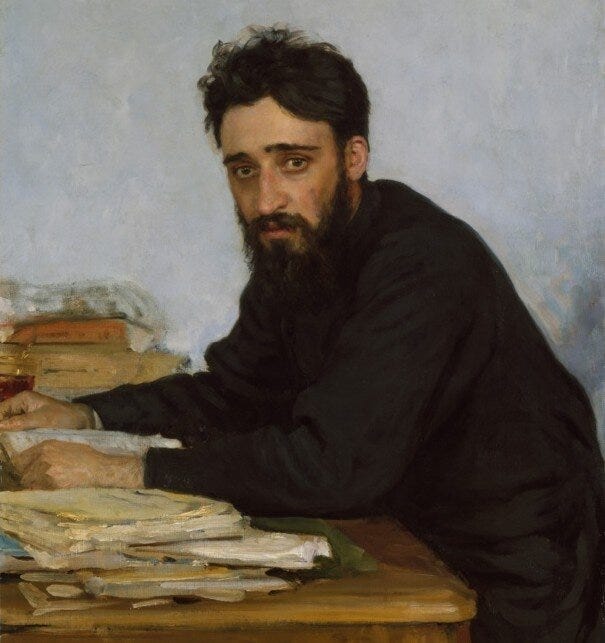
In Crime and Punishment, again by Dostoevsky, Raskolnikov, partly with the same rational justifications as the Russian characters mentioned before, murders an old pawn broker. In his mind he did the right thing, he thought that he was sure he did the right thing, but no matter how refined or elegant the theory behind his justifications were and even if he could mathematically prove that Napoleon would have done the exact same as he did, he still couldn’t live with what he had done. No one, in the entire novel, has made him suffer as much as he did, no one was as horrified by the blood on his hands as he was himself.
I couldn’t help but imagine an ever present witness, an ever luring judge gazing through his eyes, the eyes of the defendant only to then persecute him for all the misery he caused. Whether he himself agreed with the sentence wasn’t of importance to the personal courthouse Raskolnikov seemed to host inside his mind. He did what he did and would be judged nevertheless.
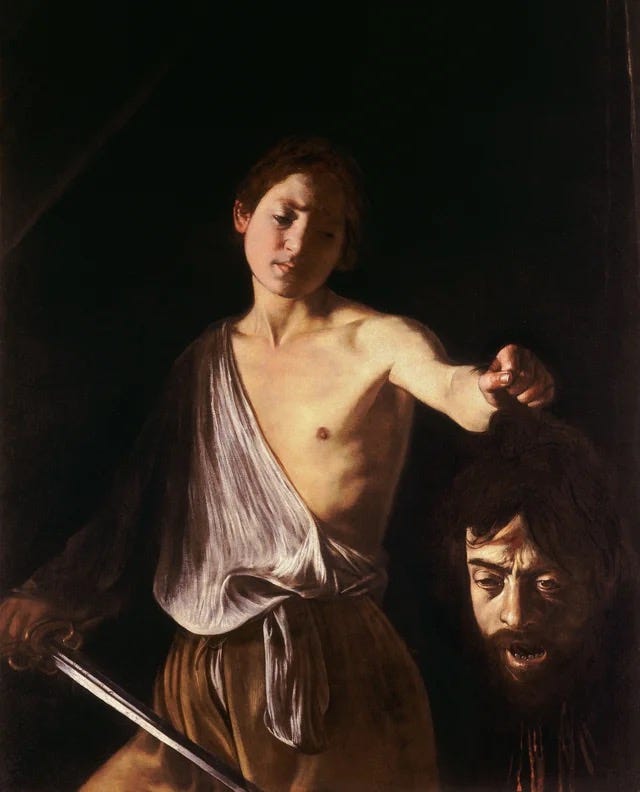
Often we try to act more morally correct around others; we behave when people are present and as soon as we are alone with ourselves we can finally let go of the bonds of ethics. No one can judge you then right? The only person left to then judge you is yourself.
Don’t people painfully underestimate the influence their own bad actions, only witnessed by themselves, can have on their self-image? They think they’re lucky that they didn’t get caught with whatever sin they committed, when they already got caught by themselves.
Interesting article, short and concise!
It's the same incalculable distance between one thought and another. The distance invariably becomes smaller the more aware one is of oneself; and this does not mean holding oneself in check; it is understanding that your motives are delible insofar as you cannot truly ascertain their source.
The difference between Raskolnikov and Ivan and Bazarov is that Raskonlikov pursued his idea to the extent that he knew it was morally outrageous. I think Raskolnikov is what Bazarov and Ivan would, to an extent, aspire to be. As you alluded to, the nihilistic, mathematical coldness they exhibited hardly ever truly seemed to be delivered in the novels; Ivan threatened to kick his hallucinations, which presented a crack in his rationalist mind.
Raskolnikov, on the other hand, was not only did he follow through but was hounded by the fact that he committed the crime, but also by the fact that he got away with it. The key aspect is that he could not allow himself to remove the guilt; and as you said, he became both judge, jury, and executioner. Petrovich only had to appeal to Raskolnikov's remorse, and it did the job. He knew there was no evidence, and hence that little push during the interrogation was all it took to allay Raskolnikov's mind.
We act 'morally' only insofar as that is defined by local expectations. Recently, this is precisely one of the arguments that I have had: these notions themselves become ambivalent in nature and disguise themselves depending on perspective. However, this does not only occur outwardly, but inwardly as well. Introspectively, we will always find excuses for why we committed such an act, akin to Raskolnikov, but most of us, unfortunately, do not end up in such turmoil. Instead, we are reassured by our conscience that what we did was, in fact, reasonable and an expectation.
Raskolnikov, from my perspective, is what good represents. And what I mean by this is the very fact that the incapability of doing wrong hardly posits that you are a naturally good person. Good, as I currently believe, arises from (a) acting out the morally wrong, (b) learning from the morally wrong, (c) having the capability to act out the morally wrong, and (d) actively choosing to act out the good in lieu of the bad.
I am unsure if you have read The Idiot by Dostoevsky, but it shows a Christ archetype, Lev Myshkin, who can only show his good-willed nature. Throughout the novel, you are more or less frustrated while reading, because there are a lot of moments where you can see that, had Myshkin had one bad bone in him, he would have been able to prevent quite a bit of misfortune to others or to himself. But he was unable to, and he folded under everyone's scrutiny. Being simply good, like Myshkin, will have you liked but not truly commended. The goodness in you becomes not virtuous but pitiful, and, in fact, people move to pity you instead. There is a major difference between unwillingness and incapability.
If we appeal to man so that, like Raskolnikov, he is able to appeal to his conscience and suffer enough to enter the mental dissolution needed to rebuild himself, quite like the alchemists would hint at, it would be a much less morally apprehensive world. However, many commit grave acts, maybe not axing individuals down, but wrongdoings nonetheless, and there is no Dostoevskian turmoil; it's simply forgotten about.
What is also interesting is that great minds are often perceived to have walking sticks or some ailments to compensate for their rationalistic minds. Ivan carries the walking stick that compensates for his specific nihilistic viewpoints; and his secularity is then troubled by the fevers, because we could allude to the fact that it was his soul, in fact, that had become polluted. Similarly, with Raskolnikov, it was his mind that began to fail and falter.
I think the hardest person to hide from is yourself. You can convince others that you did nothing wrong, and maybe even get away with it. But when you're alone with your thoughts, things can look very different. Raskolnikov is a good example of how a clever explanation doesn't always silence your conscience.