


In early February 1862, the Russian writer Turgenev published his literary novel Fathers and Sons. It was this novel that introduced the term “nihilism” to Russia. In the book, Turgenev showed the generation gap between the liberal, somewhat aristocratic generation, the “fathers” of the 1840s, and the new generation, whose values and principles he designated with the term “nihilism.”
The main character of the book, Bazarov, was the embodiment of the nihilistic younger generation. Bazarov’s nihilism is best characterized by radical materialism, devotion to the natural sciences, and a complete rejection of any authority or principle. According to him, everything that does not tell us something about the material world is useless; as far as he is concerned, the church, institutions, the emotional life, art, and romance are all worthless. His character is blunt and snappy, and he dismisses every emotion as “romantic nonsense.”
In the story, he travels through agrarian Russia together with Arkady, a young man who looks up to Bazarov. Bazarov conducts scientific research in which he dissects frogs and spends the rest of his time arguing with Arkady’s father, Nikolai Kirsanov, and his uncle, Pavel Kirsanov, about their romantic, more traditional values and principles.

Bazarov pointed out to the elders that their belief in liberal, aristocratic values or their appreciation for the poems of Pushkin were completely useless, and that they would be better off spending their time reading a scientific book or studying the innards of a frog. This caused a great deal of tension and conflict between the older Kirsanovs and the younger Bazarov and Arkady.
Eventually, because Bazarov had had enough of the Kirsanovs, he left with Arkady for another estate, that of the Sergeyevnas.
Here, the young gentlemen made the acquaintance of Anna and her younger sister Katya Sergeyevna; Anna and Bazarov got along well, as both were quite orderly and practical and shared the same down-to-earth outlook on many matters. Ultimately, their connection and Anna’s beauty led to feelings of love in Bazarov. He desperately wanted to suppress these, as they were merely a romantic distraction. Yet he failed to do so and could not help expressing his feelings anyway. Unfortunately for him, his feelings remained unrequited. The cold materialist scientist who wanted nothing to do with sentimental matters could not help getting swept away by them after all.
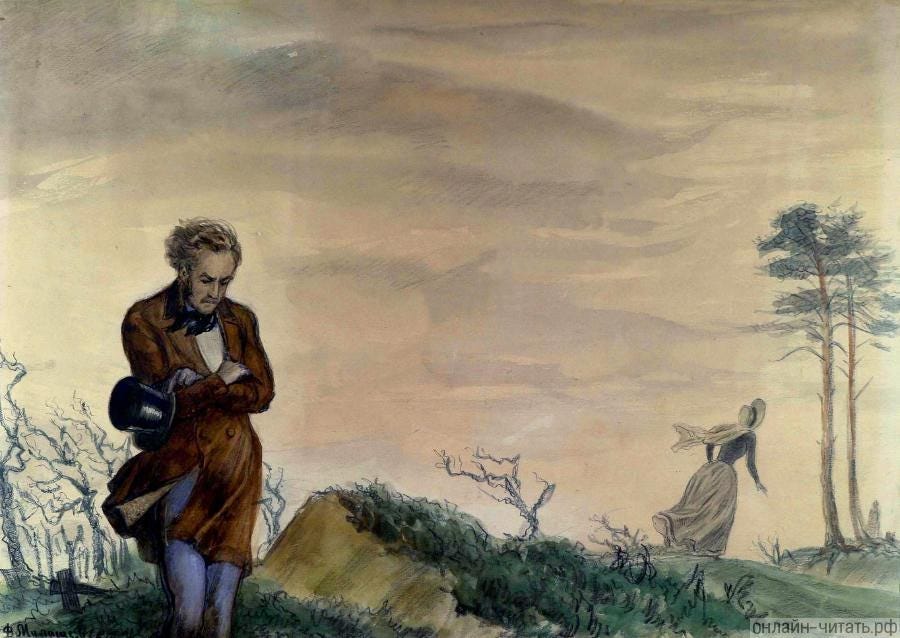
Bazarov’s situation grew worse and worse. He fell out with Arkady; the young man sensed that Arkady no longer saw him as his mentor as he had before. He saw that Arkady had gradually built up fear and resentment toward him and his ideals. The two former partners parted ways, with Bazarov returning to his parents’ estate while Arkady left for his father and uncle.
Bazarov became melancholic; he worked hard and gave himself little rest, shutting himself off and not wanting to be disturbed by his parents. His parents, who cared so much about him and were worried for him, began to fear him as well, not daring to address him when they saw him and doing everything they could to keep him satisfied.
During an autopsy of a peasant who had died of typhus, Bazarov makes a crucial mistake: he cuts himself with the knife he had previously used to operate on the deceased peasant, which had the tragic consequence of infecting him.
Bazarov became very ill; he knew immediately what was wrong with him and what his fate was. He tried to be pragmatic about it, but he failed to smoothly rationalize away his own approaching death. He was merely a sick organism, one that was now on the verge of dying. No matter how well he knew that, he could not comprehend its infinity. Even then, he tried with all his might not to fall into “romantic nonsense,” but unfortunately and understandably, this failed, as it was too much for him. A few days after the autopsy, he passed away.
When Turgenev wrote the novel, his intention was to portray Bazarov as a danger; he was disgusted by his aversion to the arts, the emotional life, and his rejection of tradition. However, the younger generation that Turgenev was attempting to describe did not see Bazarov as a villain at all, but as a hero. The man whom Turgenev wrote as a warning was praised as an example. This marked the beginning of the nihilist movement in Russia.